Wednesday, May 25, 2022

What Is Vacuum Glove Box And The Advantages Of Using Vacuum Glove Box

A vacuum glove box is used to protect operators while working with hazardous & sensitive materials. It is a sealed container, designed to work on objects that require a vacuum atmosphere. The glove box is built with an arrangement of gloves on its side, so that a user can place their hands into the gloves and perform their tasks inside the vacuum box without interfering with the inner atmosphere. The box is generally transparent to give an easy view while working.

Vacuum Glove Boxes

The global Vacuum Glove Boxes market is driven by the demand from new established laboratories & replacement of older vacuum gloves due to wear and tear. In addition, increasing awareness over biosafety encourages the use of glove boxes in research laboratories.

Factors such as stringent laboratory safety standards for employees have also boosted the growth of the vacuum glove boxes market. Moreover, significant demand from the semiconductor industry, due to rapid advancement & growth of the electronics industry has fueled the growth of the market.

The vacuum glove boxes market is segmented based on product type, end users, and geography. Based on product type, the vacuum glove boxes market is segmented rigid-plastic gloveboxes, stainless steel gloveboxes, and others.

Based on end users the market is segmented into pharmaceuticals & biotechnology, defense industry, electronic/lithium batteries, and others. Based on geography, it is segmented into North America, Europe, Asia-Pacific, and LAMEA.

Key players that operate in the market include Cole-Parmer Instrument Company, LLC, Coy Laboratory Products, Inc., Glove Box Technology Ltd., Vacuum Atmospheres Company, Inert Technology, M. BRAUN Inertgas-Systeme GmbH., Plas-Labs, Inc., LC Technology Solutions Inc., Terra Universal. Inc., and T-M Vacuum Products Inc.

Key Benefits

  • The report provides an in-depth analysis of the vacuum glove boxes industry to identify potential investment pockets.
  • The key drivers, restraints, and opportunities along with their detailed impact analyses have been elucidated.
  • Porters five forces model helps in analyzing potential buyers & suppliers and the competitive sketch of the market, which is expected to guide the market players to develop strategies accordingly.

How Vacuum Desiccator Cabinets can be used?

Vacuum desiccator cabinets are vacuum chambers made up of acrylic material. Vacuum desiccator cabinets are one of the types of desiccator cabinets. Vacuum desiccator cabinets are used to store chemical samples and pharmaceuticals dust-free and oxygen-free. Vacuum desiccator’s cabinets keep the chemical substances from oxidation reaction.

Vacuum Desiccator Cabinets


Vacuum desiccator cabinets come in different sizes and variations in a number of chambers. Single chamber vacuum desiccators cabinets are used in small laboratories and hospitals. Multi-chambered desiccator’s cabinets are also available in the market. Vacuum desiccator cabinets are safer as compared to other desiccator cabinets. Vacuum desiccator cabinets are available in round and rectangular shapes. Vacuum desiccator cabinets are also used for degassing techniques.

Why desiccator’s cabinets are used?

Desiccators Cabinets are mainly used to store chemical samples from the oxidation process. Vacuum Desiccator Cabinets are designed with vacuum chambers inside the desiccator’s cabinets. The vacuum chambers protect the chemicals from reaction with oxygen and the outer environment. It also resists humidity.

Chemicals are stored safely and air-free. Vacuum desiccator cabinets are used for storing mixed liquids, chemical substances, and samples. These vacuum desiccator cabinets are available in different sizes and designs. We can see other types of desiccator’s cabinets in the market like plastic desiccator’s cabinets, Stainless Steel Desiccator Cabinets, etc. Vacuum desiccators reduce the humidity by resisting the air using a vacuum pump or in-house laboratory vacuum.

Some standard features of vacuum desiccators cabinets by industries:

  • Come with 1 inch thick acrylic material
  • Type 1- Removable cover makes it easy to store samples.
  • Front hinged door for quick access to the samples in all chambers (Type II)
  • Door with vacuum gasket ensures air-free seal.
  • Vacuum level of 29.8″ Hg and more support by vacuum desiccators cabinets.
  • Stainless steel latches for complement corrosion resistance.

Vacuum Control Unit- Pump Accessories

Vacuum level present inside the desiccator’s cabinet is monitored by vacuum pump control unit. It automatically controls pump operation by turning the pump on/off. Non-flammable and non-corrosion gases are present inside the desiccator’s cabinet chambers.

Vacuum Pump for vacuum desiccators

The vacuum pump provides safety to the chemical substances present inside the desiccator’s chambers. It plays an important role in keeping the chemical substances from the oxidation process.

Tuesday, May 24, 2022

Key Benefits of using Stainless Steel Glove Boxes

Stainless Steel Glove box has been designed to provide a hermetically sealed environment, providing critical electrical components from being damaged. A continuous weld prevents humidity and oxygen from re-entering the chamber after backfilled with nitrogen or argon. Constructed from 304-grade stainless steel gives our glove box a strong and durable frame and its tilt-up front clear AR polycarbonate window allows large components to easily be placed inside the glovebox chamber.

Stainless steel was first produced in 1913, over 100 years ago and is one of the most common metal to be used in architecture, automotive, food, medical, and research and development industries. 304-grade stainless steel contains 18% chromium and 8% nickel providing high corrosion resistance and extremely durable.

Stainless Steel Glove Boxes

Having no pores or cracks make it impossible to harbor bacteria, viruses or dirt; making stainless steel an ideal material for surgical, medical and laboratory environments.
And not to mention, it is also aesthetically pleasing.

Benefits of Stainless Steel

  • Easy to clean
  • Strong and durable
  • Hygienic properties
  • Chemical resistant
  • Corrosion resistant
  • Aesthetically pleasing

Seam Weld (Continuous Weld)

A seam weld is a continuous weld to join two surface areas. Unlike, a stitch weld there are no gaps between the weld producing a leak-tight seam and robust bond.

Why a Stainless-steel Glove Box?

Stainless Steel Glove Boxes are essential for pharmaceutical manufacturing, the nuclear sector, research, and also production sectors, requiring the handling or use of sensitive or dangerous products. When processes require a clean, controlled atmosphere environment, Glove Boxes must be filled with argon or nitrogen. These must be kept inside the enclosure to ensure the containment of substances and materials and the maintenance of their properties.

It is good to know that stainless steel is one of the metals most commonly used in the food, medical, R&D, automotive and architectural industries. It has hygienic properties and resistance to corrosion, heat and humidity. This material also has good resistance to a wide variety of chemicals and thus allows the glove box to be easily cleaned and decontaminated.

A Comprehensive Guide to Choosing the Right Desiccator for your Needs?

We can see different types of desiccator cabinets in the market. Like plastic desiccators cabinets, vacuum desiccators cabinets, stainless steel desiccator’s cabinets, etc. Each type of desiccator’s cabinets has its specifications according to its design and manufacture. Stainless steel desiccator’s cabinet is used to store chemical substances to avoid oxidation.

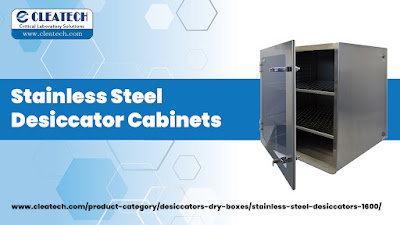
Stainless Steel Desiccator Cabinets
 

Desiccator’s cabinets are used to store chemical substances and pharmaceuticals from dust and humidity. Desiccators Cabinets are coated with some anti-oxidant agent that prevents oxygen from entering the cabinet chambers. Also, gases are filled inside the cabinet chambers to avoid humidity and the reaction of chemicals with oxygen.

Stainless Steel:

Stainless steel is a corrosion-resistant metal component. It is an alloy of iron, chromium, and some other metals. Stainless steel is also environmentally neutral and infinitely recyclable. Stainless steel is highly durable and easy to maintain. It is an extremely hygienic material. Stainless steel offers multiple benefits and has an aesthetically appealing property. It employs in various industries like transportation, research, food, building, logistics, and energy.

Working Of Stainless Steel Desiccators Cabinets

Stainless Steel Desiccator Cabinets are made with stainless steel material. These desiccator’s cabinets are said to be strong and durable. Stainless steel desiccator’s cabinets provide an effective moisture barrier that maintains humidity set points below 10% RH while minimizing nitrogen conception. Stainless steel desiccator’s cabinets also provide unsurpassed durability.

Stainless steel desiccator cabinets are ideal for your most critical low humidity storage requirements. Stainless steel like 304 and 316 stainless steel is used to make chambers. For example, the simplest model the single-chamber series 100 stainless steel desiccators cabinet. It is available in different sizes with both tempered glass and static dissipative PVC viewing windows.

Some Stainless Steel Desiccator Cabinets come with a double-wall system that includes a humidity sensor installed inside the chamber and an LED readout of the current RH level push-button control to let you program a humidity set point in seconds. The system regulates the incoming flow to keep the RH level below your set point without wasting nitrogen.


Monday, May 23, 2022

Why Do You Need To Use a Laminar Airflow Storage Cabinet?

Medical and research laboratories need to be kept free from any particulate matter that may result in contamination. The working stations need to be kept sterile devoid of any contaminants. Laminar Air Flow Cabinets are utilized in blockage of the invasion of foreign matter and dust particles into the working station thus keeping the place sterile. Parenteral preparation needs to be prepared in very sterile environments to prevent contamination.

Laminar Airflow Storage Cabinets


The Laminar hoods are used in the preparation of parenteral preparation since the devices are capable of dividing the air that flows through it into layers. The air is then got rid of the bacteria and microorganisms contamination. Medical facilities such as hospitals use the laminar airflow storage cabinets to protect patients with the compromised immune system from possible infections.

Why Have The Laminar Flow Devices?

The laminar air flow hoods provide an excellent working environment free from particulate matter. Some medical laboratory activities such as the manufacture of parenteral preparations require a highly sterile environment that is free from contaminants. The hood devices are equipped with a High-Efficiency Particulate Air (HEPA) filters manufactured from stainless steel. The filters provide a germ-free environment effective in the manufacture of IV preparations. The HEPA filters are highly effective and can remove particulate matter that measures 0.3 microns.

The laminar flow hoods make sure that the specimen, sample or products inside the cabinet are kept free from any particulate matter that may lead to their contamination. A lot of labs involved in medical, pharmaceutical, industrial and educational environment install these devices to keep the environment clean.

How To Ensure That The Hoods Are In A Good Working Condition.

The HEPA filters must be changed every month to ensure that they are in correct working condition.

The laminar flow must be having a dual DC motor since this emits low heat. The low heat emission helps in cutting down the operational costs.

Expensive hoods have “a Night Set-Back” which must be kept closed to help extend the life of the filters. The special feature helps in reducing the air flow by 30 percent.

Wednesday, April 27, 2022

Benches For Gowning: The Best Bench for All Occasions and Events

Keeping cleanrooms contaminant-free is a fundamentally crucial goal. When contaminants enter a cleanroom, it can cost a significant amount of money to remediate the facility. In extreme cases, the cost of a fast-spreading fungal, viral or bacterial infection can be human lives.

Gowning Benches

What Is A Cleanroom?

Cleanrooms are designed to prevent particle entry, purge and filter air, provide different areas for different levels of cleanliness, and isolate spaces and air pressure as needed. However, the design of the cleanroom is not enough to keep it clean.

Why Is A Consistent Gowning Procedure Important?

Some of the biggest contaminators in a cleanroom are people. Without a strict and consistent gowning and degowning procedure, you run the risk of undoing all that your cleanroom cleaning process does to protect your critical environments.

It is vital that everyone who enters a cleanroom understands the importance of following the procedures put in place to keep cleanrooms.

  • Cleanroom Gowning Procedure: Best Practices
  • Covering Up (Gowning) Steps.
  • Prepare for Gowning Benches.
  • Remove jewelry, makeup, heavy coats, sweatshirts and other "extra" items
  • Check that the tacky mat is fresh: if not, slowly pull it up toward the center and replace it with a clean tacky mat.
  • Step on the tacky mat three times, rotating to make sure your entire shoe contacts the mat.
  • Inside the room, prepare all the materials you'll need.

As you gown, take a "top-down" approach, starting at your head and working your way down.

  • Put on a cap and beard cover.
  • Check to make sure all hair is covered.
  • Select, inspect, clean, and then put on safety glasses or goggles.
  • Put on one layer of gloves (this set of gloves is considered your "gowning gloves" set).
  • Put on a coverall gown.
  • Ensure that the gown never touches the floor by gathering leg and arm cuffs and then releasing them one at a time.
  • If a separate hood is part of the gown, tuck the shoulder panels inside and under the gown before you zip.
  • Don shoe covers, one at a time as you step over the line or bench.

Note: Take extreme care to avoid contaminating the room's clean side with any contact from the dirty side.

Put on the second pair of gloves over the first and stretch them over the gown sleeve cuffs.

Tuesday, April 26, 2022

Key Benefits Of Ductless Fume Hoods

The U.S. holds over 45% of the global pharmaceutical market. Our dominance of scientific and medical fields has allowed us to raise the bar when it comes to the development and circulation of life-saving and life-changing medications. Before these medicines can be offered to the general public, however, they must undergo a grueling testing period; clean room standards must be met to ensure that they aren’t tainted or contaminated.

Laboratory Fume Hoods

From GMP storage conditions to GMP quality control, there are a number of steps and tools that play a major role in this sterile environment.

Let’s take a look at some of the benefits that ductless fume hoods in particular offer.

Environmentally Friendly: Ductless fume hoods are designed to isolate and trap chemical vapors, thereby preventing their release into the outside environment. Because these chemicals can cause ecological harm, this type of fume hood is considered to be more environmentally friendly than others.

Versatile: There are many different kinds of fume hoods for many different applications. Ductless hoods each have their own filtration system based on their specific application; carbon filters are often used to capture vapors, organic solvents, acids, and even mercury and formaldehyde. For added air purity, HEPA filters can be installed.

Easy To Install: Ductless hoods are self-contained and don’t require venting to the outside. In fact, many units are portable and can be moved around with little difficulty — no filter changes necessary. The set up, operation, and filter maintenance of ductless fume hoods are all very straightforward and easy to comprehend.

Energy Efficient: When clean, filtered air is returned to the room, the need to move air in is eliminated. As a result, the facility’s HVAC system does not have to work as hard.

Cost Effective: As their name suggests, fume hoods don’t require ducts. This means that HVAC and construction costs can be completely eliminated from the equation.

Fume hoods are a necessary part of the laboratory environment. Ductless fume hoods provide several unique advantages that put them ahead of the ducted variety. As long as you’re fully committed to maintaining your clean room standards, however, either option will do the trick.